


- Material
- 300–350 gsm board
- Lead time
- 7 days express / 15 days standard / 30 days bulk
- Quote reply
- Within one business day
- MOQ
- Confirmed at quote, by structure and size
A pillow box is a flat sheet folded into a shape with two curved sides and tucked ends, so it bulges in the middle like a cushion. It is made from one piece with no glue, which makes it the cheapest way to produce a shaped pack, and the reason it appears around confectionery, small gifts and samples.
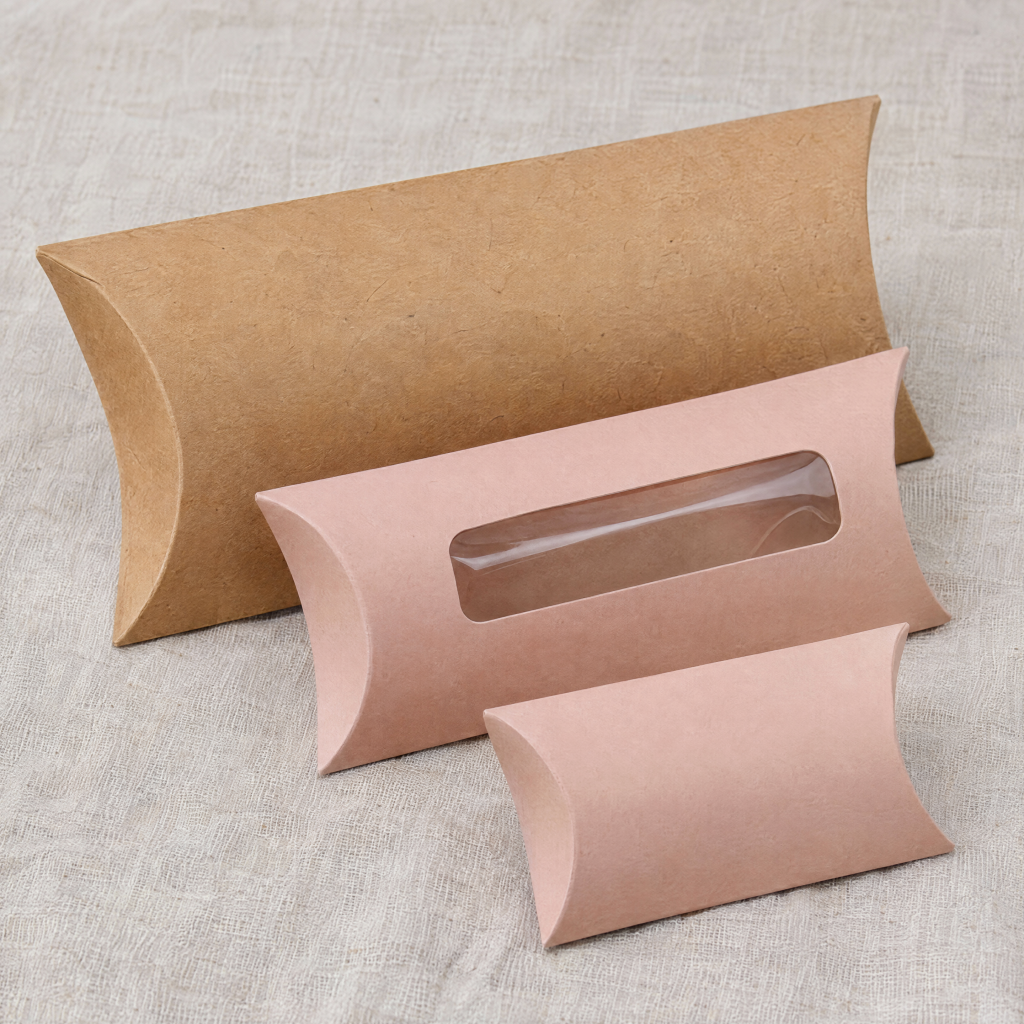
How it is built
The sheet is printed, die-cut and creased along the curved lines that form the sides, then the end tabs are cut so they can be tucked. It ships flat and is folded by hand: the body is bowed, the ends are closed and the tabs are pushed in. There is no gluing step, so the whole structure depends on the accuracy of the crease.
What to watch when you specify
The curve is a crease, not a fold, and a crease that runs across the paper grain will fight the shape. The end tabs are the closure: too shallow and they pop open under the product’s weight, too deep and they will not go in. A pillow box also has no flat face, so it cannot stand or stack, which rules it out for retail shelving without a support.
Material and size
Board has to be stiff enough to hold the curve and thin enough to tuck. A heavy board gives a crisp shape but makes the tabs hard to close; a light one closes easily and looks limp. Coated stocks print well but the coating can crack along the curved crease, so the grain direction and the crease profile have to be checked together.
| Item | Typical specification |
|---|---|
| Form | One piece, no glue |
| Closure | Tucked end tabs |
| Crease | Curved, aligned to grain |
| Board | Stiff enough to hold the curve |
| Size | Confirmed per order |
| MOQ | Confirmed at quote |
Options we build
- Curved sides with plain ends, or printed end tabs
- Single colour on uncoated stock, or full print on coated
- Window on one face for small items

What goes wrong, and how we test for it
The ends open. It happens when the tabs are too shallow for the load, or when the curve has flattened in storage and the box no longer pinches the tabs shut. The second failure is a cracked crease along the curve, which shows as a hairline on a dark print. We fold a sample and leave it loaded for a day before approving the tab depth.
Where it fits, and where it does not
Against a folding carton, a pillow box uses less board, needs no glue and gives a shaped silhouette, but it cannot stand, stack or carry much weight. Against a sleeve it is cheaper and more distinctive, and it opens from both ends, which is either a feature or a problem depending on whether the pack needs to be tamper-evident.
What drives the unit price
No gluing means no gluing line, so the unit cost is close to the cost of board plus print plus die. That makes pillow boxes cheap at volume. The die is the main fixed cost, and a curved crease needs a properly cut die: a cheap die gives a curve that wrinkles, and the wrinkle is visible on every unit.
Packing and freight
Pillow boxes ship flat, which is their advantage, and they take up very little space. Keep them flat and weighted rather than on edge, because a stack that has been stood up takes a curl and the ends will not tuck. Once filled, they cannot be stacked without deforming, so they belong in a single layer or in a divided carton.
What to send us
Send the product size and weight, and say whether the box will be handed over or shipped. A pillow box is carried, not posted. If the product has sharp corners, send it: a sharp corner will find the crease on the first handling and the box will not close again.
Other structures to compare


Related reading


Questions
Can they be shipped flat?
Yes. They are folded at the packing line.
Can they hold heavy items?
Not really. They suit light, flat products and small gifts.
Can they be windowed?
Yes, but the window reduces the curved panel strength.