


- Material
- 2.0 mm greyboard
- Lead time
- 7 days express / 15 days standard / 30 days bulk
- Quote reply
- Within one business day
- MOQ
- Confirmed at quote, by structure and size
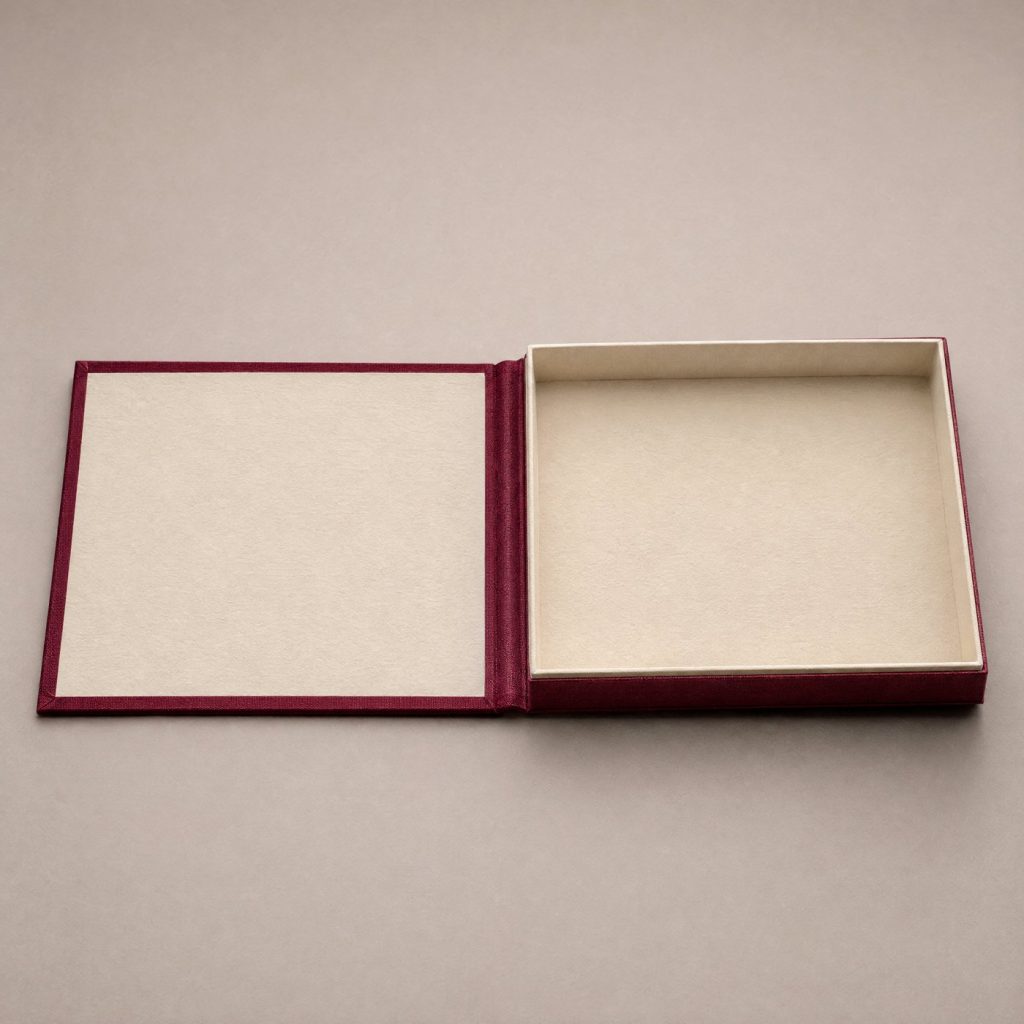
A book-style box opens like a hardback: a hinged cover on a spine, with the product sitting in a tray inside. It exists because the object reads as a book before it reads as packaging, which suits publishing, limited editions and any product that wants to be handled slowly. The spine carries every movement the box makes, and it is the part that fails first.
How it is built
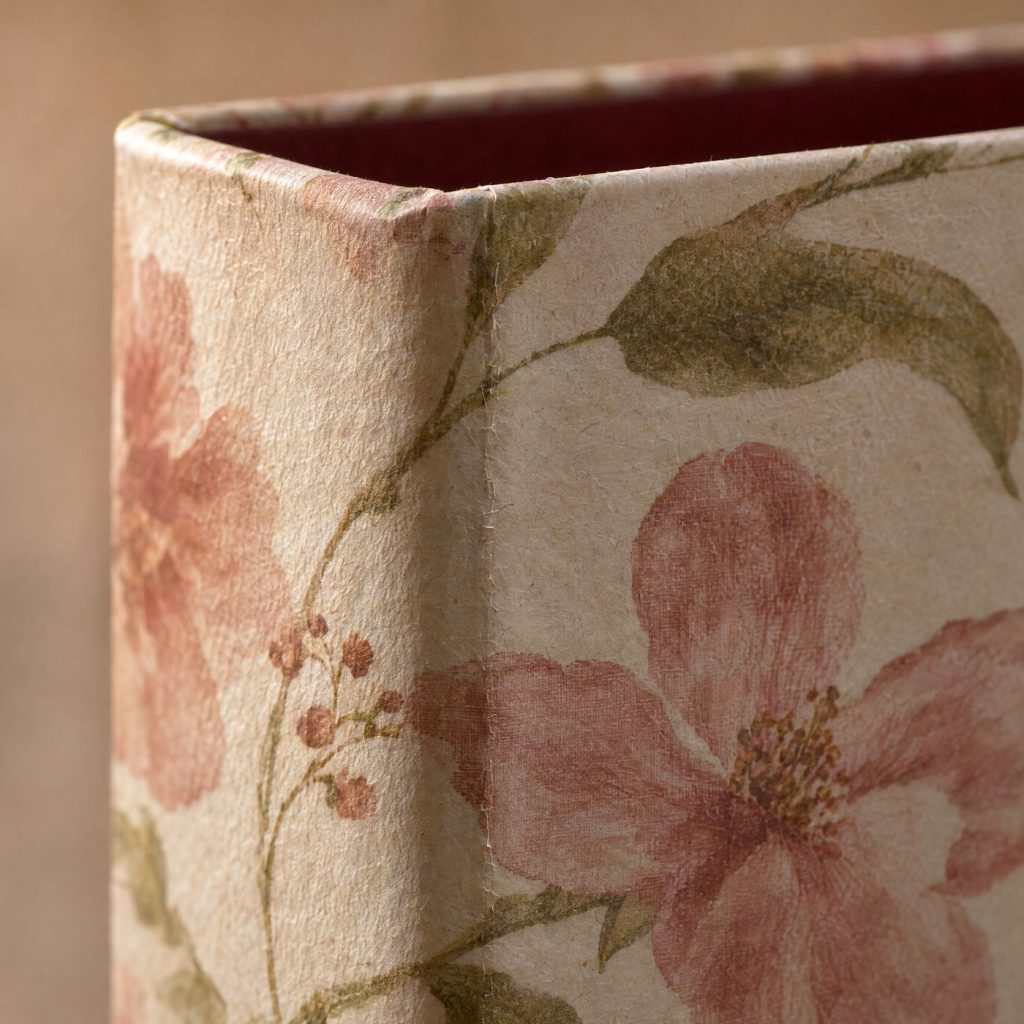
Cover board is cut and grooved at the spine, then wrapped so the paper runs continuously across the hinge. The spine joint is worked before the inner tray is attached, because the cover has to open flat without pulling the tray with it. The closure, usually a magnet or a ribbon, is positioned last, against a closed cover rather than an open one.
What to watch when you specify
Every open and close bends the same strip of paper. If the groove is too shallow the paper creases; too deep and it cracks along the fold after a few dozen cycles. The spine width has to follow the depth of the tray plus the thickness of the contents, and a spine sized by eye will either bow the cover or leave a gap at the fore-edge.
Material and size
Spine width equals tray depth plus board plus wrap, and it changes if the insert height changes. A wide cover needs a heavier board or it will sag when held by one edge. The closure choice also moves the specification: a magnet needs board thickness to house it, a ribbon needs a channel, and a tuck flap needs a fold that will survive repeated opening.
| Item | Typical specification |
|---|---|
| Cover | Hinged, wrapped across the spine |
| Spine | Tray depth plus board plus wrap |
| Closure | Magnet, ribbon, tuck or clasp |
| Insert | EVA, foam, pulp or paperboard |
| Size | Confirmed per order |
| MOQ | Confirmed at quote |
Options we build
- Magnet, ribbon tie, tuck flap or a metal clasp
- Spine printed as a continuous image across the hinge
- Inner tray fixed, or removable as a separate box
What goes wrong, and how we test for it
The failure mode is a cracked spine, and it shows up as a white line along the fold where the paper has given. The second is a cover that will not stay shut because the magnet sits too far from the edge. We cycle a sample cover open and closed before a run, and we fit the closure against the closed position, which is the only position that matters.
Where it fits, and where it does not
Against a lid-and-base box, a book-style box puts the hinge on the outside, so the product is presented rather than uncovered. Against a slipcase, it is one piece instead of two, which removes the risk of the tray being lost but makes the pack deeper. It is the wrong choice when the product is taller than it is wide, because the cover then has to be very large to clear it.
What drives the unit price
The spine is hand work: grooving, wrapping across the joint and working the hinge all take time that a flat lid does not. A magnet closure adds a pocket and an insertion step; a ribbon adds a channel. Wide covers are more expensive than the area suggests, because they need heavier board to stay flat and more pressure to press.
Packing and freight
Book-style boxes ship closed, with a band or a sleeve to stop the cover opening in the carton. Stack them flat rather than on edge, and keep the weight off the spine. If the cover is laminated, interleave with tissue: two laminated covers in contact for a few weeks in a warm container can block together and peel when separated.
What to send us
Send the product dimensions including its height, because the spine width is set by the tray depth and the contents. Tell us the opening angle you expect and whether the cover will be opened repeatedly. If the cover carries a continuous image across the spine, send the artwork laid out flat.
Other structures to compare


Related reading


Questions
Can a book-style box lie completely flat?
It can, provided the hinge allowance is correct and the spine liner is fitted. Confirm on a structural sample before approving print.
Why does the cover crack at the hinge?
Usually the wrap was cut across the grain or the groove is too deep. Both are corrected at the sampling stage.
Can it hold a bottle?
Only with a fitted insert. The hinge is not designed to carry weight, so the insert must take the load.