


- Material
- 1.5–2.5 mm greyboard
- Lead time
- 7 days express / 15 days standard / 30 days bulk
- Quote reply
- Within one business day
- MOQ
- Confirmed at quote, by structure and size
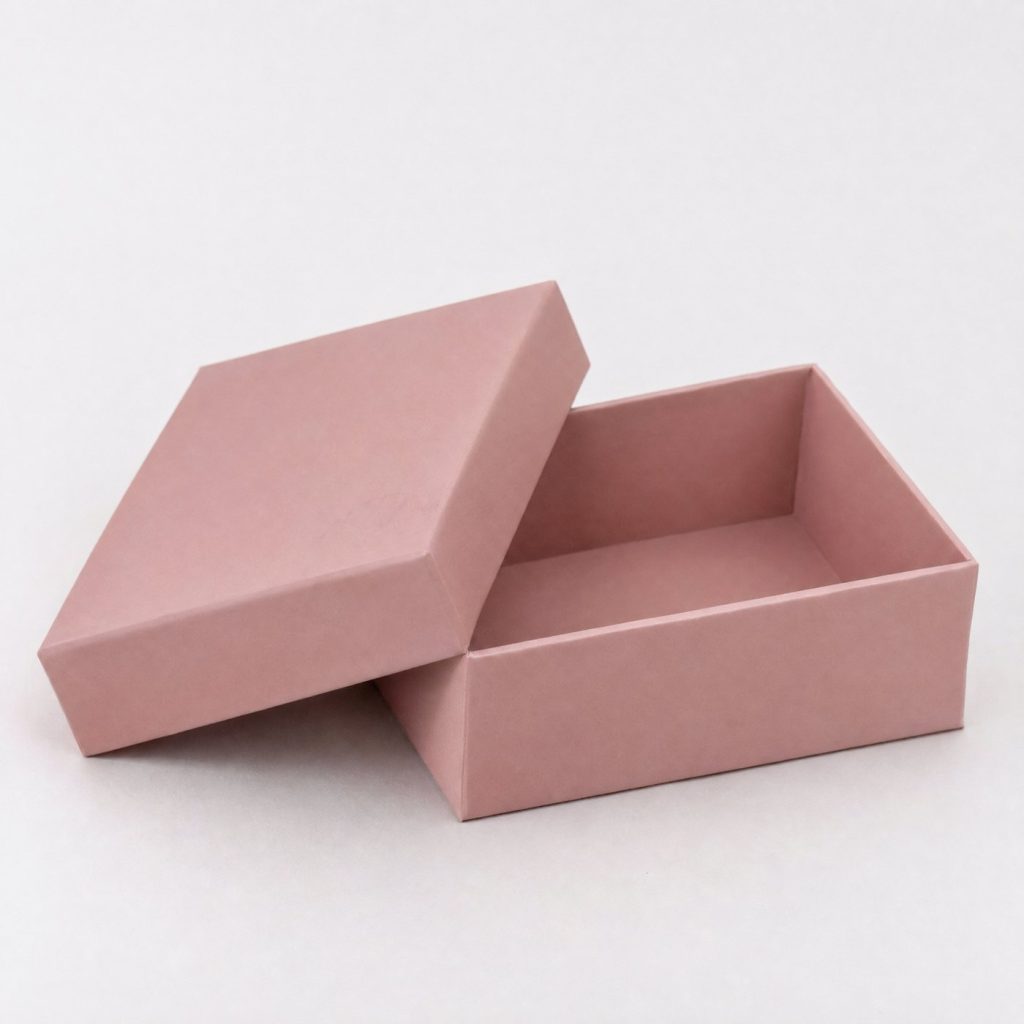
A lid-and-base box is two separately built trays that fit one over the other. Nothing holds them together except the fit itself, which is why the structure lives or dies on a few tenths of a millimetre at the overlap. It is the oldest rigid construction we make and still the cheapest way to give a product a substantial, reusable outer.

How it is built
The lid and the base are made as two independent skeletons: board cut, grooved, wrapped and cornered. They are then trial-fitted against each other, adjusted, and pressed so the pair holds its shape. The insert goes into the base before the final fit check, because a loaded base deforms differently from an empty one.
What to watch when you specify
The usual failure is a lid that fits on the sample table and comes off in the customer’s hand. Wrap thickness, board thickness and the amount the paper shrinks after gluing all move the final dimension, and they move it in the same direction on both parts only if they are made from the same batch. We cut lid and base from the same board lot and fit them as a pair.
Material and size
The overlap is set by the board plus twice the wrap, so a heavier wrap tightens the fit without anyone changing the drawing. Large or heavy boxes benefit from a base with a doubled floor or an internal ledge, which stops the walls bowing outward and loosening the lid over time. Deep bases need a finger notch or a ribbon pull, otherwise the product cannot be lifted out.
| Item | Typical specification |
|---|---|
| Construction | Two separate trays, friction fit |
| Overlap | Set by board plus wrap thickness |
| Base options | Doubled floor, internal ledge, finger notch |
| Wrap | Same lot for lid and base |
| Size | Confirmed per order |
| MOQ | Confirmed at quote |
Options we build
- Full-depth lid, or a shallow lid that shows a band of the base
- Finger notch, ribbon pull or a base divider
- Lid printed inside as well as out
What goes wrong, and how we test for it
A loose lid and a tight lid fail for opposite reasons. Loose usually means the base has grown: wrap applied too wet, or board that has taken up moisture before assembly. Tight usually means the wrap has been over-stretched at the corner, so the lid cannot seat. We keep a fitted pair from each batch and re-check them after 24 hours, once the glue has fully cured.
Where it fits, and where it does not
Against a magnetic box, lid and base removes the magnet cost and the magnet tooling, and it is the cheaper structure at any volume. What it gives up is closure: the lid lifts off, so a retail pack that hangs or ships alone needs a band, a sleeve or a shrink wrap. Against a drawer box, it is simpler to load and cheaper to make, but it cannot be opened without lifting the whole lid.
What drives the unit price
Two trays means two sets of wrapping and cornering, so a lid-and-base box takes almost as long to build as a magnetic one, less the magnet insertion. The variable that moves the price most is the fit: a tight tolerance means more trial fitting and more rejects, and that time is in the quote whether or not it is itemised.
Packing and freight
Lids travel separately or taped in pairs, because a fitted lid that rides on its base for a week in a container can arrive seized. If the pack ships assembled, add a paper band rather than tape: tape leaves residue on a laminated wrap and the customer sees it first.
What to send us
Send the product size and weight, and whether the box will be opened more than once. A pack that is opened daily needs a different fit from one opened at a launch. If the base will hold several items, send the arrangement, because the insert changes the depth and therefore the lid.
Other structures to compare


Related reading


Questions
What is the difference between a lid and base box and a book-style box?
A lid and base box is two pieces, with the lid lifting off. A book-style box is one piece with the cover connected to the body along a spine.
Will the lid fit too tightly?
It depends on the fit and the contact surface. Check the opening on the sample and account for laminate, texture and soft papers that change friction.
Can it be made in a shaped profile?
Rounded or tapered profiles are possible, but lid and base must stay matched. More complex profiles require tighter dimensional control; confirm with a white sample.