


- Material
- 1.5–2.5 mm greyboard
- Lead time
- 7 days express / 15 days standard / 30 days bulk
- Quote reply
- Within one business day
- MOQ
- Confirmed at quote, by structure and size
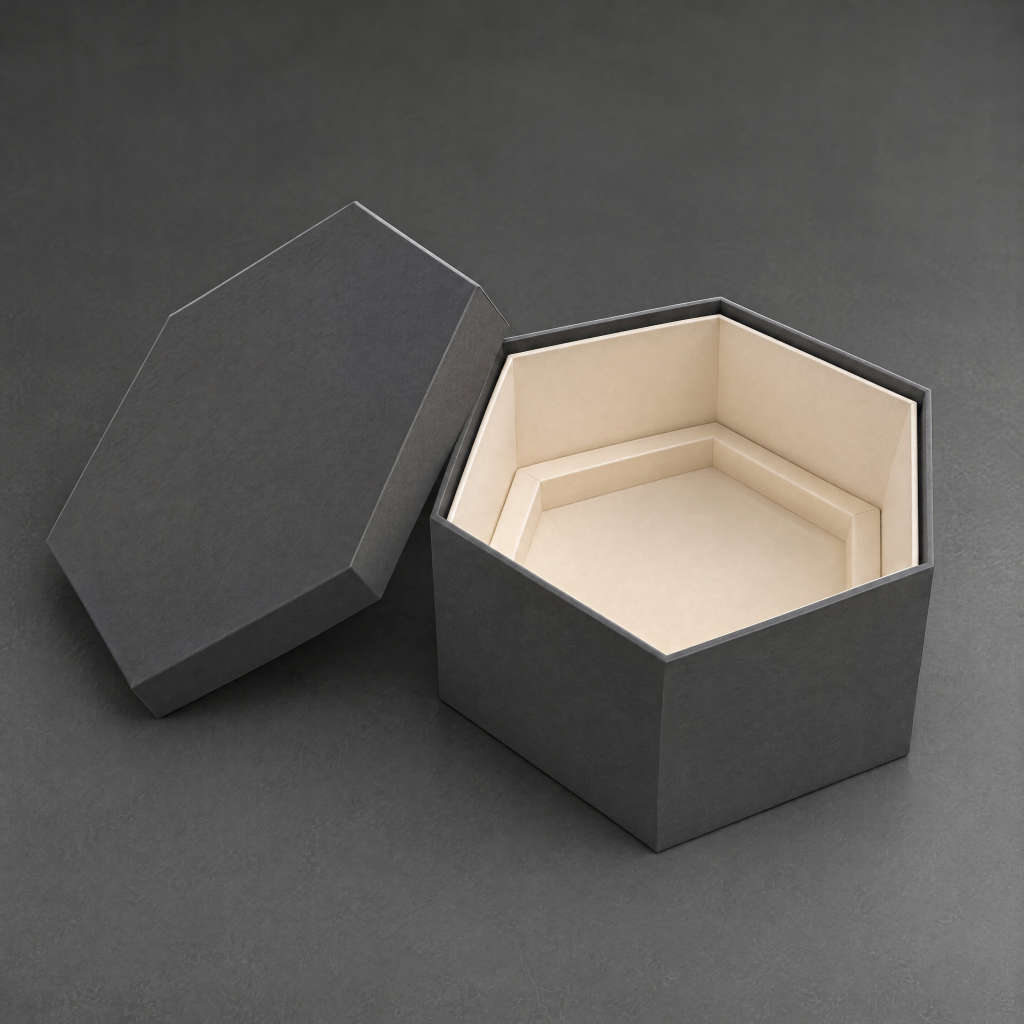
A hexagon box is built from six panels that meet at 120 degrees, which changes everything downstream: the board has to be cut in pieces rather than folded from one sheet, the wrap has to be applied in sections, and every seam becomes a place where two edges must agree. What you get is a silhouette that reads as a gift rather than a carton.
How it is built
Board is cut as separate panels and grooved where the wrap will turn. The wrap goes on in sections, or as one piece with the seams positioned at the least visible corners, and the panels are then joined edge to edge. Lid and base are fitted against each other after assembly, because a hexagon that is a fraction out of true will not seat.
What to watch when you specify
Six corners means six chances for a seam to be visible. The angles have to come from the die, not from the operator’s eye, and the wrap has to be cut with enough margin to cover the join without overlapping onto the face. On a printed wrap, a seam that lands on a colour block is far more obvious than one that lands on a neutral area, so the artwork has to be laid out around the seam positions.
Material and size
The distance across flats is the dimension that matters, not the distance across corners, and the two differ by about 15 percent. Board thickness and the way the corners are wrapped set how sharp the silhouette reads: a thick board with a tight wrap gives a crisp corner, a thin board with a soft wrap gives a rounded one. Non-regular hexagons have to be drawn, not scaled from a regular one.
| Item | Typical specification |
|---|---|
| Geometry | Regular hexagon, 120 degree internal angles |
| Dimension | Across flats, not across corners |
| Board | Cut in panels, not folded from one sheet |
| Wrap | Sectional, seams placed on artwork |
| Size | Confirmed per order |
| MOQ | Confirmed at quote |
Options we build
- Regular hexagon, or a stretched hexagon drawn to the product
- Lift-off lid or a hinged lid on one panel
- Window in one or two faces

What goes wrong, and how we test for it
The common defect is a lid that rocks because one of the six panels is slightly long. The second is a seam that opens at the top edge after a few openings, because the wrap was stretched rather than cut to size. We check all six corners against a template and test-fit the lid on a flat surface, not in the hand, since a hand can mask a rock.
Where it fits, and where it does not
Against a square box, a hexagon uses more board for the same internal volume and takes longer to assemble, so it is a presentation decision rather than an efficiency one. Against a round tube it offers flat faces for printing and a lid that can be lifted rather than pulled, which suits gift sets that need to be stacked.
What drives the unit price
Six panels mean six cuts, six wrap applications and a joining step that a four-panel box does not have. The price follows the number of seams rather than the footprint, so a small hexagon is not proportionally cheaper; the handling time per seam stays the same.
Packing and freight
Hexagon boxes ship assembled and nested only if the lid is deep enough to allow it. Because the corners are the load-bearing points, cartons need a divider grid rather than simple layer separators, or the boxes will rotate and grind against each other in transit.
What to send us
Send the dimension across flats, not across corners, and say which face should carry the print. If the box has to hold a round product, send its diameter: a hexagon that just clears the product leaves very little room for an insert. Tell us if the boxes will be stacked, because the corner seams take that load.
Other structures to compare


Related reading


Questions
Can a hexagonal box be mass produced?
Yes, but the die and the forming jig matter. Confirm the tolerance on a white sample before volume.
Can it hold a round product?
With a fitted insert, yes. Without one, the product will rotate in the six-sided cavity.
Is the lid separate?
Usually yes, in the same hexagonal profile. A hinged version is possible but costs more.